
After 15 months of being housebound, my wife, son, and I spent June visiting family and friends in CA, AZ, NM, & CO. We drove through the mind-blowing scenery of the American southwest, and, last but not least, visited two ‘agrivoltaics’ research facilities in northern Colorado. One of the Colorado facilities in particular, Jack’s Solar Garden, is a big inspiration to us. Agrivoltaics is a new trend that seeks to combine agriculture and solar energy. LittleUSA is on the growing tip of this movement.
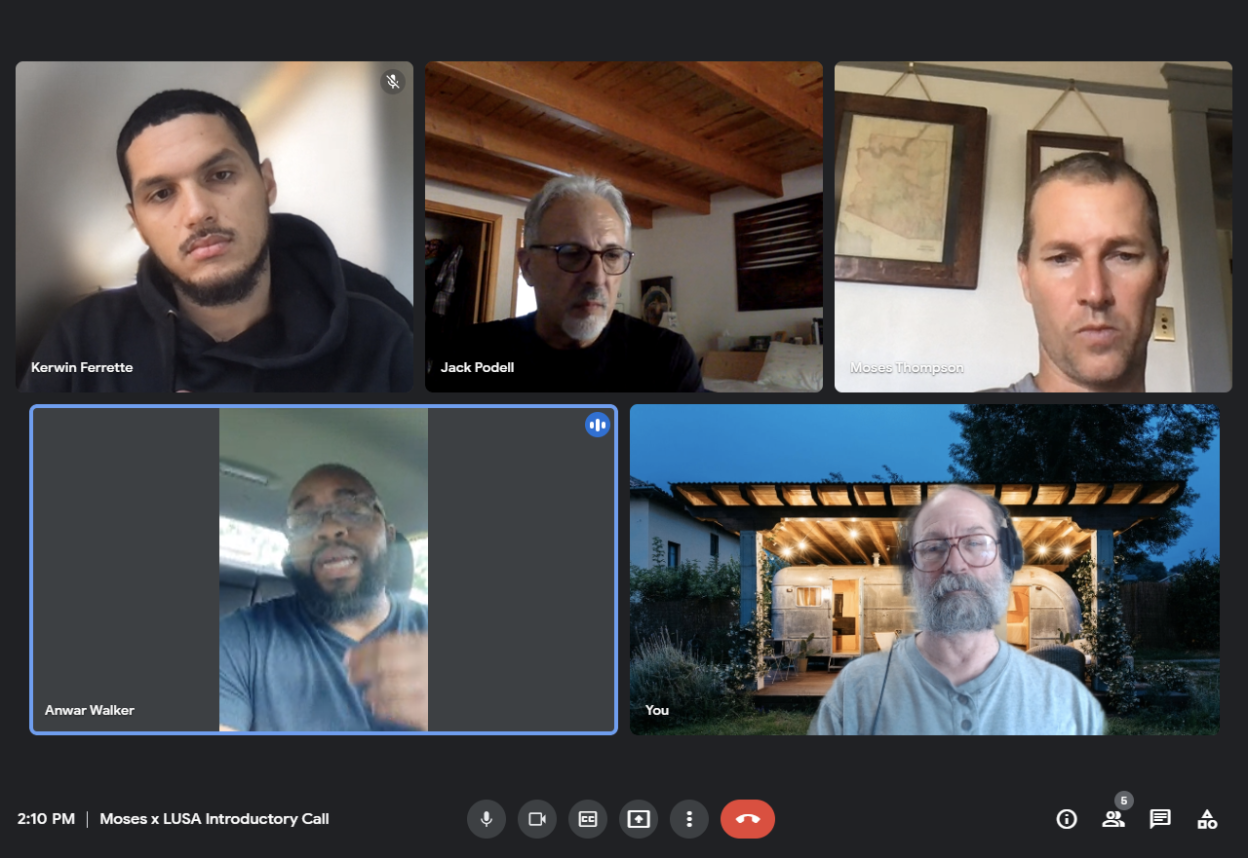
As frosting on the cake, I was privileged to join in on a video call with two teachers that are using agrivoltaic school gardens to teach. One of them, Anwar Walker, is a Union Springs Middle School STEM teacher and part of the LUSA team. The other, Moses Thompson, was a Middle School Counselor in Tuscon, AZ, who started using a school garden in 2006 to help with that. He is now the School Garden Director at the University of Arizona-Tuscon and works with agrivoltaic researchers at the University of Arizona’s Biosphere II.
To be continued…
Jack’s Solar Garden
Jack’s is a subscription farm for power. Instead of a box of green vegetables, you get green power! On our trip, we got the insiders tour from Byron Kominek (Jack’s founder), Jordan Macknick (the National Renewable Energy Lab’s agrivoltaic person), and Greg Barron-Gafford (lead agrivoltaic researcher at the University of Arizona-Tuscon).
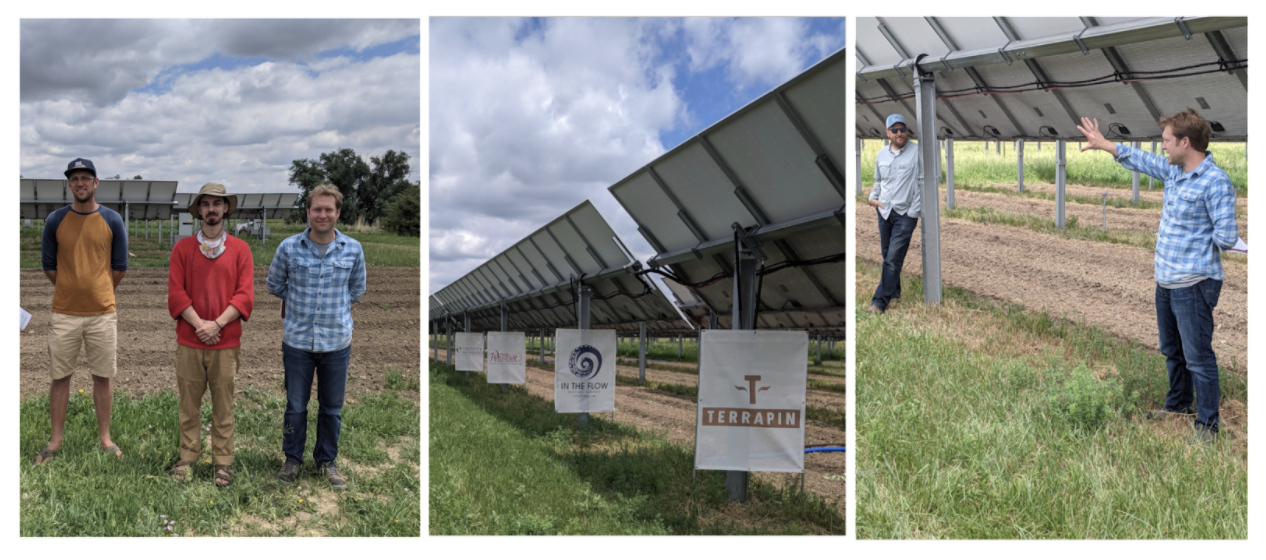
Byron, Griffin (of LUSA), & Jordan / Corporate Subscribers to Jack’s / Greg & Jordan
The farm is named after Byron’s grandfather and is on family land. Trying to figure out how to make a small acreage farm profitable, Byron decided to add a green power component. After a few years of battling to change local zoning (aimed ironically at protecting small acreage agriculture), he built out the solar facility and makes money primarily through the solar side. Early subscribers invested in the build in order to have reliable green power. In addition to four early corporate sponsors, individual households signed on to help build Jack’s.
The farming side is still experimental and Byron donates much of that land to research. We observed three types of projects:
First, there are academic projects. One is led by Barron-Gafford from the U of Az in coordination with Sprout City Farms of Boulder and focuses on how the panels interact with different crops. The U of Colorado-Ft Collins has two projects, too, one looking at panels with crops and the other with grassland.
Second, are commercial ‘prototype’ projects. One is Spout City Farms which are experimenting to find commercially viable crops. Another gives potential new farmers the use of a quarter acre free of charge to start to find out if they can succeed.
Third, are ‘sidebar’ projects. For example, a project sponsored by Audubon Rockies to grow pollinator-friendly plants near the panels.
University of Colorado - Ft Collins’ ARDEC (Agricultural Research Development & Education Center)
In addition to the two academic projects at Jack’s, U of Co-Ft Collins has a third agrivoltaic research project at their Research plot.
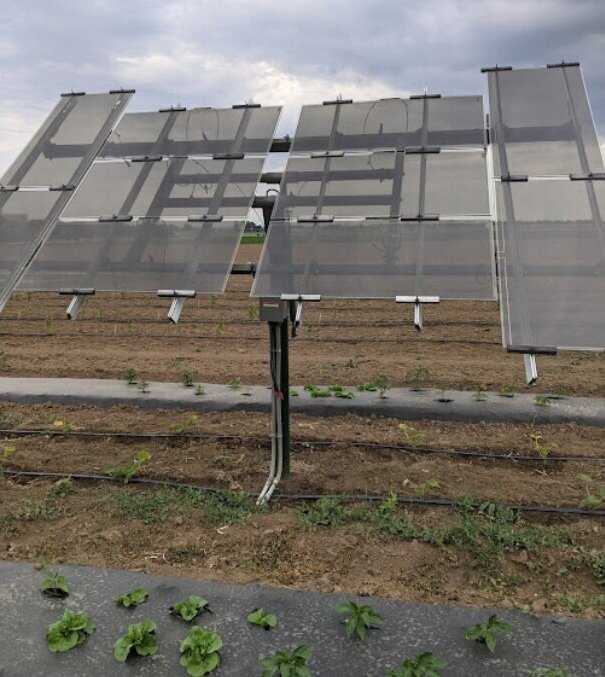
An installation designed by Tom Hickey of the U of Co and Sandbox Solar tests identical crops under three types of panels: conventional, ‘bifacial’ ones that put the solar elements on a translucent rather than opaque background, and the experimental weird ones pictured to the left. (Okay, I admit I don’t know what they’re actually called.)
We got a fascinating tour of the experimental plot and, also, of U of Co-Ft Collins’ PowerHouse. Our guide was Ian Skor, Co-Founder of Sandbox Solar. The PowerHouse is a large building that has a rapid prototyping lab and other labs devoted to everything from low particle emission wood stoves to electric race cars. The top floor houses a dozen sustainable energy startups including Sandbox Solar. We hope to find a way to work with them going forward.
Anwar and Moses
Bringing it back home to Union Springs, agrivoltaics, and education, I need to mention Anwar Walker and Moses Thompson.

Anwar is our person on the ground in Union Springs. He and Jack Podell, our lead on the education side of the project, have built up a Sustainability Club with the Bullock County school district and the local 4H. Anwar’s thing is agriculture. Some years back, he took over a single raised bed and his middle schoolers grew crops that won the Best School Garden Crop award in a 6 county competition. Things have gone from there and we are putting solar panels over Anwar’s second garden this August as part of our first Course in Solar Engineering and Installation. Moses is the pioneer of agrivoltaic school gardens. We’ve started a conversation with Moses to help develop and utilize best practices for this type of education.
One of his suggestions is to involve elders and bring in traditional knowledge. The Tuscon schools do a yearly Southwest School Gardeners’ Almanac that includes recipes and gardening tips from the parents and grandparents of the school kids. He believes this type of community involvement is essential.
